The Doorway to Your Subconscious Before Sleep

Most of us do not think much about the last few minutes before sleep.
We scroll, think about tomorrow, replay conversations, check one more message, then eventually fall asleep.
Joseph Murphy and Neville Goddard believed those final minutes could be used very differently.
Both taught that the subconscious mind plays a major role in shaping our lives, and that the relaxed state before sleep is one of the easiest times to work with it.
Why the subconscious matters
Your conscious mind is the part of you that analyzes, questions, plans, and makes decisions.
Your subconscious holds learned patterns, memories, emotional associations, habits, and beliefs that can influence how you react and behave without you consciously deciding each response.
Joseph Murphy wrote about this extensively in The Power of Your Subconscious Mind. His basic idea was that ideas repeated with enough feeling can become accepted by the subconscious, and once something feels normal or true internally, it can begin influencing the way you think and act.
Neville Goddard took the idea further.
He believed imagination could be used deliberately to give the subconscious a new assumption about who you are and what is possible for you. In Neville's philosophy, those inner assumptions eventually become reflected in your outer life.
That is the spiritual side of the teaching.
But there is also a very practical idea underneath it: what you repeatedly think, expect, and emotionally rehearse can influence the patterns you live from.
Why before sleep?
Murphy and Neville both paid particular attention to the period just before sleep.
When you are lying in bed and becoming drowsy, you are usually not analyzing everything as intensely as you do during the day. It becomes easier to stay with one thought, image, or feeling without immediately arguing with yourself about whether it is realistic.
Neville called this the state akin to sleep.
His practice was simple.
Get comfortable, relax, and imagine one short moment that would make sense if what you wanted had already happened.
If you want love, imagine a moment where you already feel loved.
If you want confidence, picture yourself handling something confidently.
If you want a new opportunity, imagine telling someone the good news.
The goal is to spend a few minutes feeling what it would be like if the outcome were already real.
Then fall asleep.
Joseph Murphy approached it slightly differently
Murphy often suggested giving the subconscious an idea before bed and then leaving it alone.
That could be something you want to believe.
A problem you want help solving.
A decision you need clarity on.
Or simply a feeling you want more of.
His approach was less about forcing an answer and more about trusting that the subconscious could continue working while the conscious mind rested.
You have probably experienced a version of this yourself.
You go to bed stuck on something and wake up with a clearer answer.
Or something that felt impossible the night before suddenly seems much simpler in the morning.
There is some science around that too.
In a 2021 experiment, people who briefly entered the earliest stage of sleep were much more likely to discover a hidden solution to a problem afterward than people who stayed fully awake. Researchers described sleep onset as a creative sweet spot.
That is one of the reasons the space between awake and asleep is so interesting.
Think about what usually gets the last word at night
For a lot of us, it is whatever happened to be on our phone.
A video.
A message.
An argument.
Tomorrow's workload.
Something embarrassing we said five years ago that our brain suddenly decided to bring back at 11:42 p.m.
Then we fall asleep.
You do not need to become afraid of negative thoughts or monitor every sentence in your head.
This is much simpler than that.
You can choose to spend the final few minutes of the night with something you actually want to carry forward.
Try it tonight
Pick one thing.
Maybe there is something you want.
Maybe there is a feeling you want to experience more often.
Maybe there is a problem you cannot stop thinking about.
If you are using Neville's approach, imagine one short scene that implies it has already worked out.
Keep it simple.
Do not create a twenty minute movie in your head.
A hug.
A conversation.
Seeing your name on the email.
Looking in the mirror and feeling good about yourself.
Waking up peaceful.
If words feel easier, use those instead.
“I trust myself.”
“I am loved.”
“I am safe.”
“I know what to do.”
“Things are working out.”
You do not need to repeat the sentence fifty times.
Let yourself settle into it and fall asleep.
You can also bring a question to bed
If you are stuck on something, try asking yourself a simple question before you sleep.
What am I missing?
What would make this easier?
What is the right next step?
Then stop trying to solve it.
Murphy believed the subconscious could continue working on problems after the conscious mind had stepped away.
Even without taking that as a spiritual law, giving yourself permission to stop forcing an answer can be useful.
Sometimes clarity comes after you stop chasing it.
Bedtime does not need to become another routine to perfect
This is probably the most important part.
You do not need candles, a twenty step ritual, a manifestation playlist, or a perfect mental state.
You are already going to spend a few minutes lying there before you fall asleep.
The idea is simply to use those minutes with a little more intention.
Neville used them for imagination.
Murphy used them for suggestion, prayer, and problem solving.
Science has found that the transition into sleep can support unusual connections and insight.
Different explanations, similar opportunity.
Instead of ending every day inside the same worries, you can end it with an idea you actually want to grow.
And if the subconscious really does play a major role in the patterns we live from, that may be one of the simplest places to begin.
This article is for educational and reflective purposes. Joseph Murphy and Neville Goddard are presented as spiritual and self development teachers. Their ideas about the subconscious and manifestation should not be treated as established scientific fact.
Read more
The books behind this post
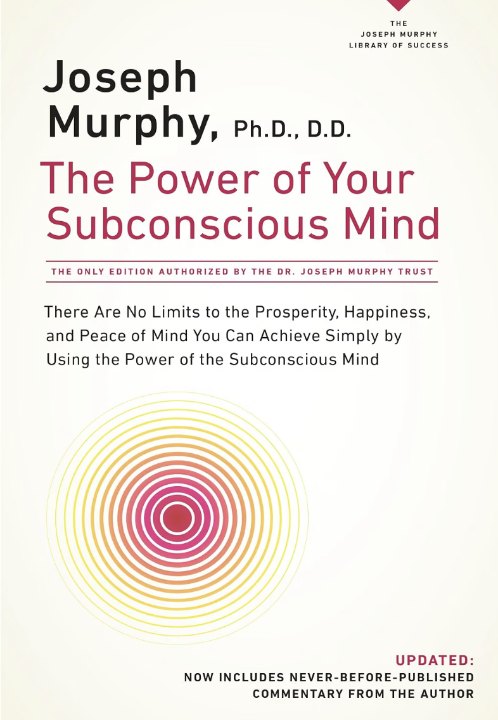
The Power of Your Subconscious Mind
Murphy’s classic on how the subconscious shapes your health, relationships and success, and how to work with it.
Buy now
The Neville Goddard Deluxe Collection
Neville’s lectures and books in one volume, including Feeling Is the Secret.
Buy nowSome links are affiliate links, meaning AÏA may earn a small commission at no extra cost to you.
Sources
- Joseph Murphy. The Power of Your Subconscious Mind. Especially the chapters on sleep, suggestion, prayer, and problem solving.
- Neville Goddard. Feeling Is the Secret, Chapter 2: Sleep. Neville's teachings on imagination, sleep, and the state akin to sleep.
- Lacaux C, Andrillon T, Bastoul C, et al. Sleep onset is a creative sweet spot. Science Advances. 2021.
- Ghibellini R, Meier B. The hypnagogic state: A brief update. Journal of Sleep Research. 2023.